Interview With Student - Dr. Franz
When I sing, I forget everything that weighs on me
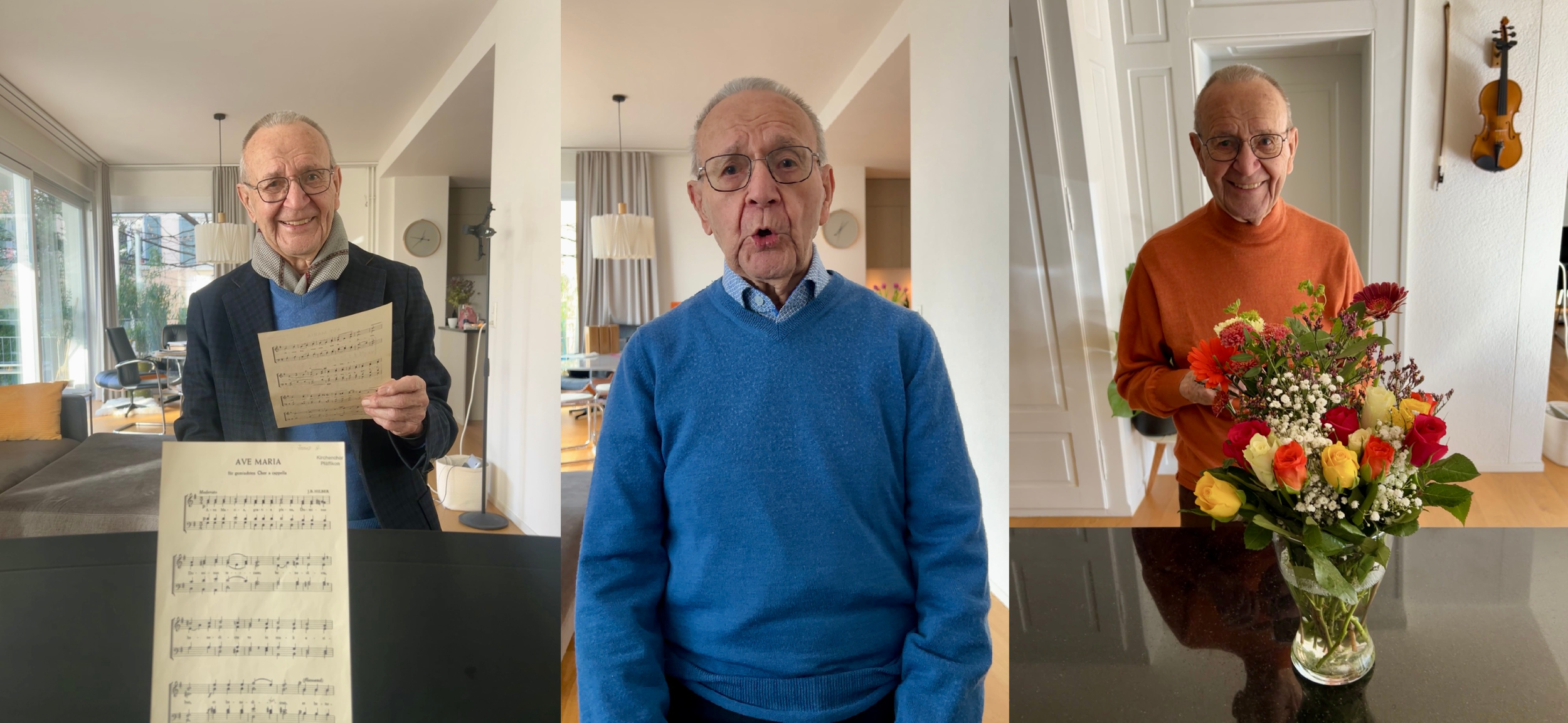
Dr. Franz Holzmann is a retired dentist, violinist, yodeler, tenor — and, at 94, still a regular student with Petra. We spoke about music as a form of resistance, about memory that lives in the voice, and about why singing, as he says himself, is simply part of what it means to be human.
Franz Holzmann arrives at his lesson smiling and on time — as always. In his hand, he carries sheet music for choir rehearsals; in his pocket, a magazine clipping about health and singing that he has been meaning to show his teacher all week. In nearly four years of lessons, he has missed almost none. Not even after eight days in the hospital. As soon as I got home, he says, I wanted to sing again.
Petra Andrensek, April 2026
You grew up in a rural environment in the canton of Lucerne in the 1930s. What role did music play in your home?
Quite an important one, although I didn’t fully realize it at the time. My brothers, my father, my grandfather — they all sang Gregorian chant in the church choir. My mother played guitar, my sister the lute, my brother the clarinet. I played violin and trumpet. We were quite a musical family. A violin lesson cost one and a half francs — that was the fee for the village organist and teacher. My father didn’t want to pay. My mother paid with eggs she sold from our chickens. He knew nothing about it. At home, we sang many folk songs with our parents — while working together in the kitchen, while pumping water. It was truly beautiful.
“My mother paid for violin lessons with eggs. My father knew nothing.”
Did you have a radio at home?
Yes, we did. But the neighbors had a slightly better one — through it you could pick up German stations and hear Hitler, Goebbels, Göring. They played it loudly through the window. I was a child, but I read the newspaper every day. Often, I knew more about the war than the adults. At night, we could hear the bombers flying over Switzerland — from England, on their way to bomb Milan and other Italian cities.
Did anything during the war leave a musical impression on you?
Yes. During the war, a traveling salesman came to us, selling coffee — he was part of an organization for Jewish refugees. We asked him what he had done before. He said: I sang. In the opera. We asked him to sing something for us, and he agreed. He took his stance and sang an aria from the operetta Carovič. It was incredible. He had an exceptionally trained voice. I never forgot that.
“Ba-bam, ba-bam — it lifts you. Singing is a remedy.”
You said you practiced the violin in secret — your father disapproved. Why?
I went up to the attic. In winter, it was cold — my breath froze in the air. But I practiced anyway. When he hit me, I said: this is not right. He hit me again. I said it again: this is not right. In the end, my mother said to him: You cannot silence Franz’s mouth. It simply doesn’t work. Later, my brother told me that my father was jealous of me — because I did what was expected of me, but I would not be controlled.
So music was a form of resistance?
I think so. Singing, playing, acting — I simply felt that it belonged to me. And when I was struggling financially as a student and didn’t want to lose courage, I played in a wind band. I would sing a marching rhythm to myself — ba-bam, ba-bam — and it lifted me. You don’t give up. You keep going. Singing is a remedy against depression and despair.
You were already 91 when you started lessons at Voice of Petra. What brought you here?
I wanted to sing for as long as possible. I noticed that during choir singing my throat would itch and I would tire quickly. I met Petra as a patient — she came in for an X-ray. When I asked what she did, she said: I teach singing. I remembered that. Later, I called her and asked if I could come for a lesson. And that’s how it has been ever since.
“When I sing Sanctus, I think: this is grand. You must step into it.”
Did you ever imagine you would still be singing tenor at your age?
Never. We started with Ave Verum Corpus and folk songs. Then we progressed slowly — Creation, Der Freischütz, Hallelujah. When I sing Sanctus, I think: this is grand. This is theater. You must step into it. I am the one standing before God — that is how you must sing it. That is what my grandfather taught me: you are not just someone reading text. When you sing, you become that person.
The German word Gemüt has many layers — soul, disposition, inner state. What exactly do you mean when you say singing nourishes your Gemüt?
Gemüt is an inner constitution, but also a posture that expresses itself outwardly. Today, now that I no longer have professional obligations, I move through the world differently. On the tram or on the street, I usually have a smile on my face. Sometimes I laugh without fully knowing why. And I’ve noticed: if you move through the world with a gentle, open smile, it becomes a posture that spreads to others. And that comes from singing. Without music, without singing — I cannot imagine it.
After eight days in the hospital, you returned immediately to lessons. Why?
Because singing mentally replaces so many other things. When I leave a lesson, I walk proudly through the street. I feel it. And that feeling stays with me for a long time. Even in the hospital, I sang. For my roommate, an Italian patient — I played the role of a mason’s assistant from an opera and sang. He laughed and was very happy. Singing is wherever I am. The choir conductor knows he can rely on me — that I am steady, dependable. Among singers, that has meaning. Rehearsals are always the most beautiful part of my day.
“At yodeling festivals, everyone is happy. There must be something in it that simply brings joy.”
In your lessons, you sing church music in Latin, arias in German and Italian, and Swiss folk songs — in Swiss German and Romansh. How do you experience this diversity?
As natural and beautiful. In church, it is right to sing church music — that is the place and the occasion. In the yodeling choir, Swissness comes fully into its own. At home, we had a farm worker who always yodeled while milking. He had a beautiful yodeling strength. Yodeling expresses feelings — the weather, life, where not everything is always rosy. At yodeling festivals, five to ten thousand people gather — and they all go home happy. There must be something in this singing that simply brings joy. Swiss yodeling is protected by UNESCO and is completely different from the Austrian or Bavarian versions.
Do you wonder whether these traditions are still being passed on?
That is the task of the active generation — parents and schools. Unfortunately, there is too much imitation of American styles. We cannot do that. We are yodelers. Gospel singers have completely different breathing, a different physical foundation — it sounds entirely different. Folk songs, operetta, classical singing — these must be preserved. They belong to life.
You once told me: singing connects, encourages friendships — instead of wars and envy. That’s a powerful statement.
It comes from experience. During the war, patriotic songs had to be sung to maintain morale and lift spirits. In my sixties, I organized a singing circle with old friends from my student days. Once a month, we gathered, opened the windows, and sang. The neighbors praised us: how beautiful it was. Those were special times.
What would you say to someone your age who is considering singing lessons? Join a choir. Find a choir, take singing lessons, and you will have your place. You learn to write, you learn many things — why wouldn’t you learn to sing? Everyone can sing. Birds learn to sing too. Young crows don’t sing very well at first. But they learn. Proper singing must be learned — especially breathing. Old crows, on the other hand, forget again.
Did you know that my other students are mostly international professionals from all over the world? What do you think about being part of such a diverse community, even if you only met a few of them before and after your lessons?
I find that interesting. It shows that what we do here is not something local or narrow. Singing connects, regardless of where you come from. And the variety of people feels rich. It is beautiful that it exists.
“Find a choir. Take singing lessons. You will have your place.”